






A summary of results from the second Cameroon Population-Based HIV Impact Assessment – known as CAMPHIA 2024-2025 – demonstrate notable progress toward bringing the long-running HIV epidemic in the country under control while also highlighting the persistence of critical challenges that must be addressed going forward.
The summary results of CAMPHIA 2024-2025 were presented on July 7, 2026, during an event in Cameroon’s capital, Yaoundé, led by the country’s Minister of Public Health and the Chargé d’Affaires, ad interim (CDA) at the U.S. Embassy in Yaoundé. The event brought together representatives from the Government of the Republic of Cameroon, the U.S. Government, and other stakeholders supporting the national HIV response.
“Today’s release of the CAMPHIA 2024-2025 summary results is both a celebration of progress and a call to action,” said Dr. Manaouda Malachie, PhD, Cameroon’s Minister of Health, during his remarks (in French). “It confirms that Cameroon is moving in the right direction while reminding us that more work remains to ensure every individual knows their status, accesses treatment promptly, and achieves sustained viral suppression.”
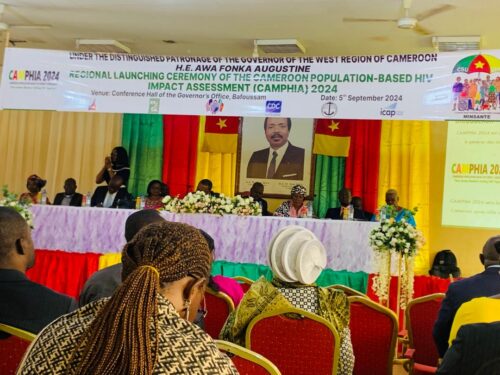
The CAMPHIA 2024-2025 launch in the West Region on September 5, 2024 was chaired by the governor with active engagement and featured participation of key stakeholders in the region.
A household-based national survey led by the Government of the Republic of Cameroon, primarily through the Ministry of Public Health (MoH) and the National Institute of Statistics, CAMPHIA 2024-25 is part of the global Population-based HIV Impact Assessment project – the PHIA project – which, over the course of more than a decade, has conducted more than 25 surveys designed to capture the state of the HIV epidemic in the most-affected countries. CAMPHIA 2024-2025 is the second PHIA survey to be conducted in Cameroon, following CAMPHIA 2017-2018.
Carried out between September 2024 and January 2025, CAMPHIA 2024-2025 covered nearly 15,000 households and interviewed about 27,000 adults (15+ years of age) throughout the country, offering HIV counseling and testing with return of results to survey participants. In addition to collecting information about uptake of HIV care and treatment services, the survey also gathered information on behavior, access to prevention and care services, and the main determinants of HIV infection.
Like CAMPHIA 2017-2018 before it, CAMPHIA 2024-2025 estimated national HIV incidence, which refers to the number of new HIV cases, and national and regional HIV prevalence among adults, which refers to the proportion of the adult population living with HIV. The survey also estimated the national and regional prevalence of viral load suppression, which occurs when HIV in the blood is reduced to a level that improves the health of the individual while also preventing onward HIV transmission – a factor that is critical to achieving epidemic control.
The results of the survey reflect encouraging progress in the fight against HIV in Cameroon. According to the survey, national HIV prevalence is estimated at 3.0% among people aged 15 years and older, or about 501,000 people living with HIV. The survey shows annual incidence to be 0.13%, corresponding to approximately 21,000 new infections each year.

A team of CAMPHIA 2024-2025 data collectors engage in household listing training for the survey in the Center Region in March 2024.
The survey results also provided information on Cameroon’s progress toward achieving the 95-95-95 global HIV targets. These targets, which chart a course toward eventual epidemic control, aim for 95% of all people
living with HIV knowing their status; 95% of diagnosed individuals receiving sustained antiretroviral therapy (ART); and 95% of those on ART achieving viral suppression. The CAMPHIA 2024-2025 data show that among adults living with HIV, 77.1% know their HIV status. Of these, 96.4% are receiving antiretroviral treatment, while 95.0% of people on treatment have achieved viral load suppression. While the second and third numbers demonstrate achievement of these important goals, the first represents a persistent gap, highlighting the need to scale up screening strategies, particularly for men, adolescents, young adults, and hard-to-reach populations.
“CAMPHIA gives Cameroon a clear picture of where the HIV epidemic stands and where the response must go next, said F.E. Harrison, MBA, PMP, deputy country director for the US Centers for Disease Control and Prevention (CDC) in Cameroon, in her remarks. “Unlike routine program data, CAMPHIA is a nationally representative household survey that reaches people both inside and outside the health system. It tells us not only who is accessing HIV treatment, but also who is living with HIV and remains undiagnosed.”
CAMPHIA 2024-2025 was led by the Government of the Republic of Cameroon, through the Ministry of Health and the National Institute of Statistics (NIS). Financial support was provided through the US President’s Emergency Plan for AIDS Relief (PEPFAR) with technical assistance from the CDC. CAMPHIA 2024-2025 was implemented by the Cameroon Baptist Health Convention Board (CBCHB), NIS, and ICAP at Columbia University in collaboration with Government of Cameroon entities including the Division of Health Operations Research (DROS), National AIDS Control Committee (NACC), National Public Health Laboratory (NPHL), the Department of Disease Control, Epidemics and Pandemics (DLMEP), the Department of Pharmacy, Medicines and Laboratory (DPML), the Research Center on Emerging, Re-emerging Diseases (CREMER), the Chantal Biya International Reference Centre for Research on HIV/AIDS Prevention and Management (CIRCB), as well as district, regional, and referral hospitals, and local government authorities.
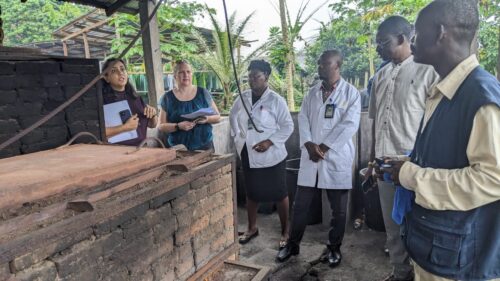
A CDC laboratory team visits the South West Region in November 2023 to assess the NEID Reference lab at Mutengene for use as a satellite or central lab for the survey.
“Conducting a nationwide survey of this magnitude is no small undertaking,” remarked John G. Robinson, MIA, the US CDA. “Planning for CAMPHIA began in 2023 and required years of preparation, coordination, and commitment. From designing survey protocols and training field teams to collecting and analyzing data from households across the country, every stage of the process depended on extraordinary teamwork and professionalism.”
The results from the survey were shared publicly in the form of a summary sheet. The final report with full results from the survey along with data sets for use by researchers are scheduled to be made available later in the year on the PHIA website.
“CAMPHIA 2024-2025 represents another chapter in the continuing story that the PHIA project is telling about the global response to the HIV epidemic in the most-affected countries,” said Erika Fazito, MSc, DHSc, ICAP’s director of the PHIA project. “We are grateful to the dedicated and effective partnership, and especially to the people of Cameroon, who made the collection of this data possible.”
“With each PHIA survey, we are painting a clearer picture of the progress being made and the lives been saved through global public health efforts,” said Wafaa El-Sadr, MD, MPH, MPA, global director of ICAP and principal investigator of the PHIA project. “At the same time, these surveys are helping illuminate the areas where resources are still needed so that progress can continue. For these reasons, the PHIA surveys are making a critical difference in the march toward achieving a world without AIDS.”


